
A domain name as investment strategy now meets institutional-grade due diligence standards, treating premium domains as a distinct alternative asset class alongside collectibles, fine art, and intellectual property. This classification rests on verifiable scarcity, legally transferable ownership recorded through registrar and WHOIS systems, and a documented history of appreciation tracked across public sales databases. Evaluating a domain name as investment therefore requires the same rigor applied to any traditional alternative asset – comparable sales analysis, liquidity assessment, and long-term utility review.

Institutional buyers, family offices, and individual investors are no longer asking whether a domain can hold value; they are asking how to price it correctly. If you’re exploring ultra premium domain names for sale, understanding the underlying asset mechanics first will save you from costly missteps later. This guide breaks down exactly why domains behave like real financial assets, and how to evaluate one before you commit capital.
What Actually Makes a Domain Name a Legitimate Alternative Asset
An alternative asset, by definition, sits outside conventional stocks, bonds, and cash. Real estate, fine art, wine, and collectibles fall into this bucket because they share three traits: limited supply, transferable title, and independent price discovery. According to Investopedia’s definition of alternative investments, these assets typically move independently of traditional markets, which is exactly why sophisticated investors use them for diversification.
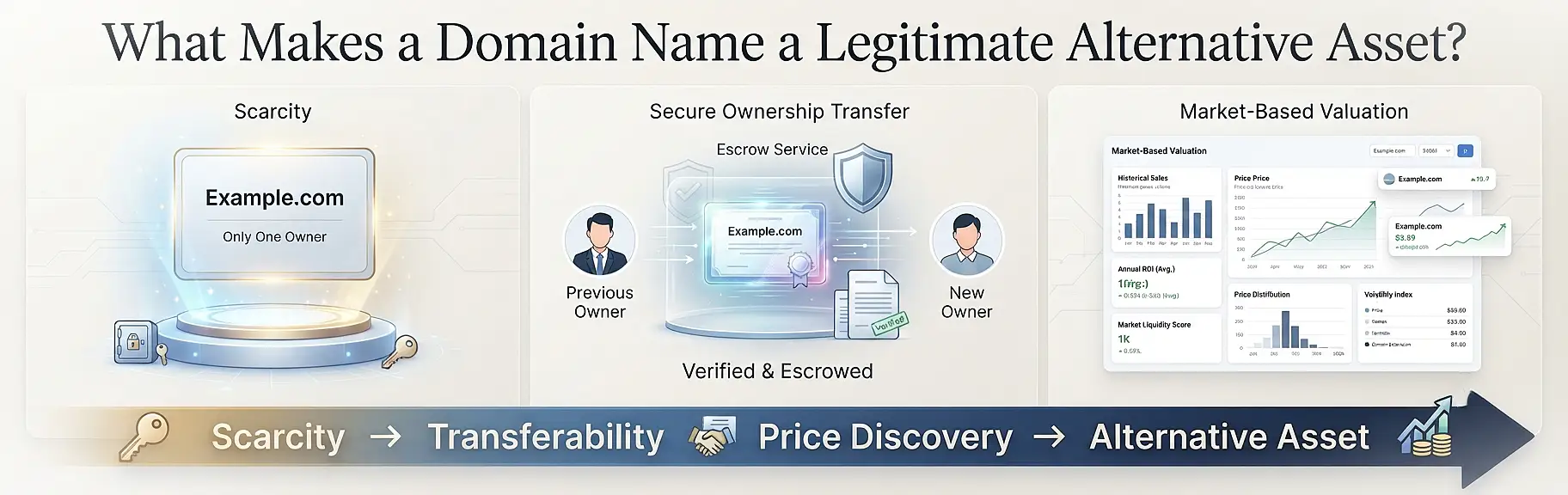
Unlike many digital products that can be duplicated infinitely, premium domain names have built-in scarcity. There can only be one owner of a particular domain-extension combination, which creates exclusivity and long-term value potential. This characteristic makes domains similar to prime real estate, where location and uniqueness directly influence market price.
Another reason domains qualify as alternative assets is that they often appreciate independently of stock market performance. During periods of economic uncertainty, businesses still require strong online branding, which keeps demand for high-quality domain names relatively stable. Because of this, some investors use domains as a diversification tool alongside traditional investments.
Furthermore, premium domains can generate indirect value even before resale. They can attract direct traffic, improve brand recognition, and reduce marketing costs for businesses, adding another layer of economic utility that many collectibles lack.
Taken together, these characteristics position premium domains as a legitimate and increasingly recognized alternative asset class.
Why Institutional Investors Are Paying Attention to Domain Assets
For years, domain investing was viewed as a niche activity practiced primarily by entrepreneurs and internet marketers. That perception has changed dramatically. Institutional investors increasingly recognize premium domains as scarce digital assets with characteristics that resemble intellectual property and commercial real estate.
Several factors have accelerated this shift:
- The growth of digital-first businesses.
- Rising acquisition costs for premium brand names.
- Increased transparency in domain sales data.
- Greater understanding of digital asset diversification.
Large corporations now routinely allocate substantial budgets toward acquiring strategic domains because the right name can become a long-term competitive advantage.
Scarcity: There’s Only One of Each
Unlike shares of a company, which can be issued in unlimited tranches, a domain name is singular. Once “example.com” is registered, no other entity on earth can own that exact string on that exact extension. This absolute scarcity is closer to owning a specific parcel of land than owning a stock certificate.
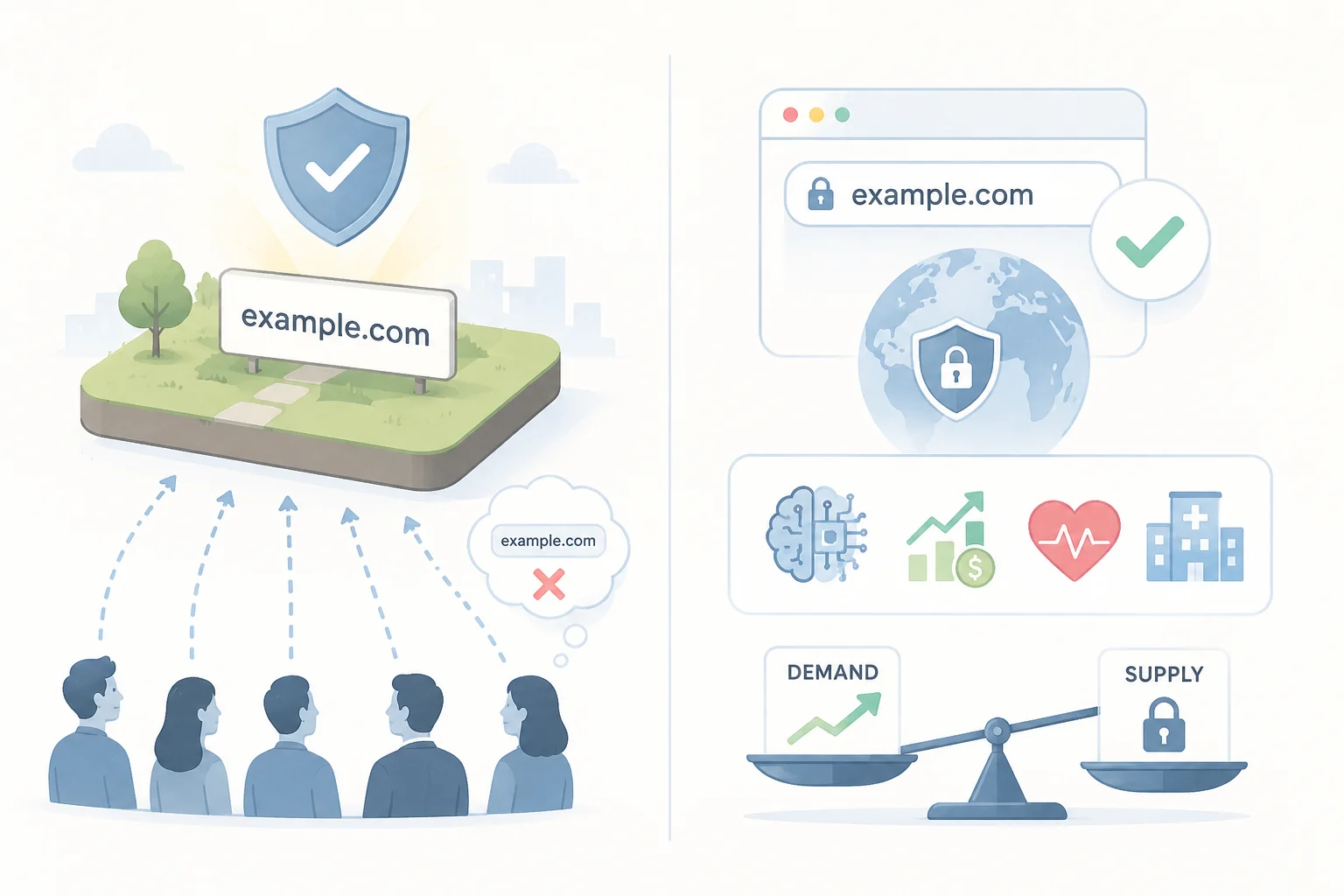
Beyond creating exclusivity, scarcity also intensifies competition among businesses. Startups, established brands, and investors frequently pursue the same small pool of high-quality domains because a memorable name can provide long-term branding and marketing advantages. As a result, premium domains often command higher prices simply because suitable alternatives are limited.
This limited supply becomes even more important in sectors such as AI, fintech, and healthcare, where companies are willing to pay substantial premiums for the right digital identity. As more businesses enter the online economy, demand continues to rise while supply remains permanently fixed.
Transferability: Ownership Is Legally Recognized
Domain ownership is recorded through registrar systems and governed by policies overseen by ICANN’s domain registration framework, which establishes clear rules for transfer, dispute resolution, and rightful ownership. This means a domain can be bought, sold, escrowed, and legally transferred with the same clarity as a deed or title.
One of the strongest arguments for considering domains as investment assets is their clear ownership framework. Domain ownership records can be transferred globally within a matter of days, making them far easier to move than physical assets such as real estate.
Modern escrow services and registrar systems have also made transactions safer and more transparent. Buyers and sellers can verify ownership, complete payments securely, and transfer assets without complex legal procedures.
Standardized transfer procedures also reduce transaction risk and make premium domains accessible to international buyers, further strengthening the global domain marketplace.
Price Discovery: Historical Sales Set the Benchmark
Public marketplaces and aftermarket sales platforms record thousands of completed domain transactions annually, creating a comparable-sales framework similar to how appraisers value real estate or rare art. This is precisely why understanding the technical factors behind domain valuation matters before assigning a price tag to any name.
Price discovery in the domain market has improved considerably over the past decade. Investors now have access to extensive databases of historical transactions, allowing them to compare similar sales and estimate fair market value.
Comparable sales also reveal broader market trends. By studying transactions within specific industries or extensions, investors can identify which types of domains are gaining demand and which categories may be losing momentum. This market intelligence helps investors make more informed acquisition and pricing decisions.
The growing transparency of pricing data has helped domains mature into a more professional asset class and has increased confidence among institutional buyers.
How to Evaluate a Domain Name as Investment: The Core Framework
Once you accept that a domain qualifies as an asset, the next step is pricing discipline. Evaluating a domain name as investment isn’t guesswork – it follows a structured framework similar to underwriting any alternative asset.
A professional domain valuation should consider both quantitative and qualitative factors. Quantitative metrics include search volume, historical traffic, and previous sales data, while qualitative factors include memorability, pronunciation, and brand appeal.
Investors should also consider future market trends. A domain that appears ordinary today may become highly valuable if it aligns with emerging industries such as artificial intelligence, renewable energy, or blockchain technology.
The most successful investors rarely rely on a single factor. Instead, they combine multiple indicators to develop a balanced and realistic valuation.
Here’s a quick-reference table summarizing the primary evaluation criteria:
| Evaluation Factor | What to Check | Why It Matters |
|---|---|---|
| Length & Structure | Character count, hyphens, numbers | Shorter, cleaner strings are easier to recall and type, driving higher resale demand |
| Extension (TLD) | .com, .ai, .io, ccTLDs | .com remains the most liquid and universally trusted extension globally |
| Brandability | Pronounceability, memorability | Brandable names attract end-user buyers, not just other investors |
| Keyword Relevance | Search volume, commercial intent | High-intent keywords can generate direct type-in traffic and SEO value |
| Sales Comparables | Recent transactions in the same category | Establishes a realistic price floor and ceiling |
| Legal Cleanliness | Trademark conflicts, WHOIS history | Avoids disputes that could freeze or void a resale |
Quick Definition: What Is Domain Valuation?
Domain valuation is the process of estimating a domain’s fair market price by weighing scarcity, brand potential, keyword strength, and historical comparable sales, rather than relying on registration cost alone.
Domain Names vs. Other Alternative Assets: A Comparison
Compared with traditional alternative assets, domains offer several unique advantages. They require almost no physical maintenance, involve minimal storage costs, and can be transferred globally without shipping or logistical challenges.
Another advantage is accessibility. Investors can begin building a domain portfolio with relatively small amounts of capital, whereas real estate or fine art often require significant upfront investment.
Domains also have exceptional scalability. Managing hundreds of domains is significantly easier and less expensive than managing multiple physical properties.
| Asset Type | Liquidity | Storage/Maintenance Cost | Barrier to Entry | Price Transparency |
|---|---|---|---|---|
| Premium Domain Names | Moderate (weeks-months) | Very low (annual renewal fee) | Low-Moderate | Moderate (via sales databases) |
| Fine Art | Low (months-years) | High (insurance, storage) | High | Low (opaque auction pricing) |
| Real Estate | Low (months) | High (taxes, upkeep) | Very High | Moderate-High |
| Gold | High (days) | Moderate (storage/security) | Low | High |
Notice that premium domains occupy a favorable middle ground: minimal carrying costs, reasonable liquidity, and increasingly transparent pricing data compared to art or unlisted collectibles.
Common Mistakes Investors Make When Treating a Domain Name as Investment
Even experienced investors misjudge domains when they apply the wrong mental model. Watch out for these frequent errors:
Many new investors purchase domains based purely on personal preference rather than market demand. Just because a name sounds appealing does not necessarily mean businesses will pay a premium for it.
Another common mistake is chasing trends too aggressively. Buying hundreds of domains related to a temporary trend often results in large renewal costs and poor resale opportunities.
Investors should also avoid emotional pricing. Overestimating a domain’s value can lead to years of unsold inventory and unnecessary carrying costs.
- Confusing registration cost with market value: A $12 registration fee has no bearing on resale potential.
- Ignoring extension hierarchy: Assuming a .net or .org will command the same premium as an equivalent .com.
- Skipping comparable sales research: Pricing a domain purely on gut feeling instead of verified transaction history.
- Overlooking trademark risk: Buying a name that overlaps with a protected brand, which can trigger legal disputes later.
- Underestimating holding patience: Expecting quick flips instead of planning for a realistic multi-year appreciation cycle.

Expert Tips for Building a Domain Name Investment Portfolio
Consequently, seasoned domain investors follow a few consistent principles:
- Diversify across categories: Mix short brandables, keyword-rich names, and emerging-industry terms rather than concentrating in one niche.
- Prioritize .com whenever feasible: Alternative extensions can perform well, but .com still carries the deepest end-user demand.
- Track renewal costs against holding timeline: Since annual fees are low, patience is affordable, but budgeting still matters for large portfolios.
- Use escrow services for every transaction: This protects both buyer and seller during ownership transfer.
- Reassess valuations annually: Search trends and industry terminology shift, so a name’s value should be revisited periodically.
Step-by-Step Guidance: How to Start Investing in a Domain Name
If you’re ready to move from theory to action, follow this practical sequence:
- Define your budget and category focus – decide whether you’re targeting brandables, keyword domains, or industry-specific terms.
- Research comparable sales – study recent transactions in your target category to set realistic price expectations.
- Verify legal cleanliness – run a trademark check and review WHOIS history before making an offer.
- Negotiate through a broker or marketplace – this adds a layer of price validation and transaction security.
- Complete the transfer via escrow – never send payment directly without an escrow intermediary.
- Document the acquisition – record purchase price, date, and rationale for future portfolio tracking.
Frequently Asked Questions
Is a domain name really considered an investment asset?
Yes. A domain name qualifies as an alternative asset because it meets the core criteria of scarcity, legally transferable ownership, and a track record of appreciation, which is why institutional buyers and private investors increasingly treat premium domains as portfolio holdings rather than simple website addresses.
How much can a premium domain name appreciate over time?
Appreciation varies widely by category, but short, brandable, and single-dictionary-word .com domains have historically shown compounding annual growth in the high single to double digits, with many six- and seven-figure resale transactions recorded on public marketplaces over the past decade.
What makes one domain name more valuable than another?
Value is driven by length, extension, memorability, keyword relevance, brandability, existing search traffic, and historical sale comparables, with shorter and more universally applicable names generally commanding higher premiums.
How do I evaluate a domain name as investment before buying?
Evaluate a domain the way you would any alternative asset: check comparable sales data, assess brandability and pronounceability, confirm the extension’s market acceptance, review any existing backlink or traffic history, and verify clean legal ownership through WHOIS records before finalizing a purchase.
Are domain names a liquid investment?
Domain names are less liquid than stocks or bonds but more liquid than real estate, since a well-priced premium domain can often be sold within weeks to months through established marketplaces, brokers, or direct outreach to end-user buyers.
Why Premium Domain Names Continue to Appreciate in Value
The increasing digitization of business operations has created sustained demand for memorable and authoritative online identities. As competition intensifies, companies are willing to invest more heavily in premium domains that strengthen their brands and improve customer trust.
Because the supply of high-quality domains is permanently limited, many investors believe that the best digital assets will continue to become increasingly scarce and valuable over time.
Treating a Domain Name as Investment the Right Way

Ultimately, a domain name as investment deserves the same disciplined evaluation you’d apply to real estate, art, or precious metals – not less. Scarcity, legal transferability, and growing price transparency have already earned domains a legitimate seat among alternative assets; what’s left is applying sound due diligence before you buy. If you’re ready to explore verified, high-caliber holdings, and start building your portfolio with names backed by real market data.
As digital commerce continues to expand, premium domains are becoming increasingly important strategic assets for businesses and investors alike. Those who approach domain investing with patience, proper research, and disciplined portfolio management may benefit from long-term appreciation while maintaining relatively low carrying costs.