
Domain name valuation is determined by a multi-variable framework that weighs technical signals – such as TLD authority, character length, phonetic structure, and historical link equity – against market-driven forces including comparable transaction data, category liquidity, keyword commercial intent, and end-user buyer pool depth. Understanding how domain names are valued requires analyzing both the intrinsic attributes of the asset itself and the external market conditions that govern price discovery. Together, these 11 factors form the professional appraisal model used by domain brokers, institutional investors, and corporate acquisitions teams worldwide.
Whether you have just inherited a domain, received an unsolicited offer, or are preparing to invest in digital real estate, knowing what drives genuine market value is critical. Domain pricing is not arbitrary – it reflects a sophisticated intersection of branding psychology, SEO infrastructure, intellectual property law, and supply-demand dynamics in a finite, non-reproducible asset class.
If you are exploring the acquisition of ultra premium domain names for your business or investment portfolio, understanding the valuation mechanics behind six- and seven-figure transactions will position you as an informed buyer rather than a reactive one.
What Does “Domain Valuation” Actually Mean?
Domain valuation is the process of estimating the fair market value of a registered domain name based on a combination of quantifiable data points and qualitative judgment. Unlike stock or real estate appraisal, no single standardized model governs domain pricing. A $10 registration fee can yield a domain worth $10,000 or $10 million – the gap is explained entirely by the 11 factors explored in this article.
Domain values operate on a broad spectrum:
- Commodity domains: Common registrations with no distinguishing characteristics. Value: $10 – $500.
- Aftermarket domains: Names with some branding or keyword merit. Value: $500 – $25,000.
- Premium domains: Strong single-word or category-defining .com names. Value: $25,000 – $500,000.
- Ultra premium domains: Generic, brand-grade, or category-dominant .com assets. Value: $500,000+.
Factor 1: TLD Extension and Registry Tier
The top-level domain (TLD) is arguably the single most powerful determinant of baseline value. The .com extension remains the global gold standard for commercial credibility, trust signaling, and resale liquidity. According to Verisign’s domain industry brief, .com accounts for the largest share of registered domains globally – and this concentration itself creates compounding value.
TLD value tiers at a glance:
| TLD TIER | EXAMPLES | RELATIVE VALUE |
|---|---|---|
| Tier 1 (Global Default) | .com | Highest – 10x premium vs. alternatives |
| Tier 2 (Country Authority) | .co.uk, .de, .io | Strong in regional/tech contexts |
| Tier 3 (Niche Extensions) | .net, .org, .ai | Moderate – use-case dependent |
| Tier 4 (New gTLDs) | .shop, .tech, .xyz | Generally low secondary market value |
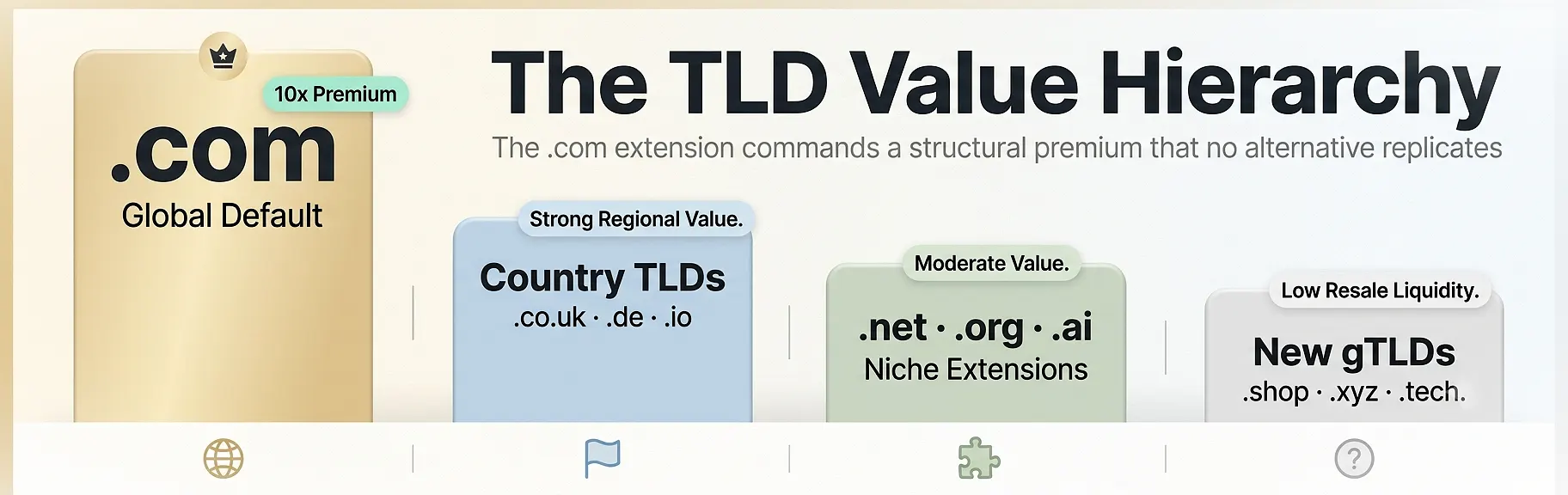
Key insight: The same word registered as a .com versus a .net can differ in market value by 5x to 20x, depending on category. For investment-grade assets, .com exclusivity is non-negotiable.
Factor 2: Character Length and Phonetic Simplicity
Shorter domains are exponentially more valuable. This is not a preference – it is a measurable market reality reflected in every sales database. The reasoning is structural:
- Fewer characters reduce typo risk and cognitive load.
- Short domains perform better in voice search, audio advertising, and verbal brand communication.
- Single-word and two-character domains occupy a permanently finite supply.
Domain length and relative value (approximate ranges):
| CHARACTER COUNT | EXAMPLE | TYPICAL .COM VALUE RANGE |
|---|---|---|
| 1-2 characters | X.com | $1M+ (extremely rare) |
| 3 characters | NUQ.com | $10,000 – $200,000+ |
| 4 characters | APEX.com | $5,000 – $100,000+ |
| 5-6 characters | Brand.com | $1,000 – $50,000+ |
| 7-10 characters | Keyword phrase | $500 – $20,000 |
| 11+ characters | Long phrase | Sub-$1,000 typically |
Beyond raw length, phonetic ease matters enormously. A domain that passes the “radio test” – meaning it can be heard once and correctly typed without clarification – commands a premium over one that requires spelling confirmation. Hyphens, double letters, and numerals all depress this score and therefore reduce appraisal value.
Factor 3: Keyword Commercial Intent and Search Volume
Domains containing high-intent, commercially valuable keywords carry built-in SEO leverage and category authority. A domain like Insurance.com or Loans.com is not just a web address – it is a permanent signal of topic relevance that search engines, users, and buyers immediately recognize.
What makes a keyword commercially valuable in a domain context?
- High monthly search volume (tens of thousands of searches per month or more)
- Strong commercial intent (the search leads to a purchase decision)
- Industry category leadership (the word defines or dominates its niche)
- Global applicability (not limited to a single language or geography)
The relationship between keyword value and domain price was demonstrated clearly in the landmark sale of Insurance.com for $35.6 million – at the time one of the largest publicly recorded domain transactions. According to NameBio’s historical sales database, the top publicly reported domain sales are consistently dominated by exact-match, high-commercial-intent keywords in the .com extension.
Practical valuation note: Use tools such as Google Keyword Planner, Ahrefs, or SEMrush to quantify the commercial intent score of any keyword embedded in a domain before assigning estimated value based on this factor alone.
Factor 4: Brandability and Memorability Score
In 2025 and beyond, brandability has emerged as the single most influential factor in domain value, according to research from Dynadot’s domain industry insights report. A domain does not need to be a dictionary word to be highly brandable – but it must be:
- Easy to pronounce in one attempt
- Easy to spell without ambiguity
- Memorable after a single exposure
- Free from negative connotations in target markets
- Emotionally resonant or evocative of a category
Characteristics of highly brandable domain names:
- Follows natural phonetic patterns of the target language
- Contains no more than three syllables ideally
- Avoids uncommon consonant clusters (e.g., -nght, -rsk)
- Carries positive or neutral connotations cross-culturally
- Works as both a noun and a verb (e.g., Zoom, Slack, Stripe)
Domains that score highly on brandability attract end-user buyers – the companies and entrepreneurs who need the name for active business use – rather than only speculative investors. End-user transactions generate the highest realized sale prices, which is precisely why brandability is so central to how domain names are valued in the premium tier.
Factor 5: Domain Age and Historical Continuity
Domain age is frequently cited as a valuation factor, but its role is often misunderstood. The raw age of a domain (years since first registration) has limited independent value. What matters is the continuity and quality of use over the domain’s history.
Age-related factors that positively affect value:
- Consistent registration history with no expiration gaps
- Long-standing association with a single brand or topic
- Historical presence in authoritative directories and references
- Accumulated citation mentions across the web
Age-related factors that negatively affect value:
- Periods of domain parking with no active site
- Multiple ownership changes indicating instability
- Significant drops in use or visibility over time
A domain registered in 2001 that has been actively developed as an authoritative site in its category will carry substantial age-based value. A domain registered in 2001 that has sat parked for 20 years offers comparatively little age premium. As confirmed by analysis at DN.org, age alone is not a ranking factor – the authority and trust built over time through consistent content and backlink acquisition are what actually drive value.
Factor 6: Backlink Profile and Domain Authority
A domain with a strong, organic, editorially earned backlink profile is worth significantly more than an identical domain with no link history. This is because the backlinks represent:
- Accrued SEO authority that transfers to any site built on the domain
- Evidence of historical credibility and third-party endorsement
- A head start in organic search rankings for any future owner
Key metrics to evaluate when appraising backlink value:
| METRIC | WHAT TO CHECK | TOOL TO USE |
|---|---|---|
| Domain Rating / Domain Authority | Overall link strength score | Ahrefs, Moz |
| Referring Domain Count | How many unique sites link back | Ahrefs, SEMrush |
| Link Quality | Spam score and editorial vs. paid links | Majestic, Moz |
| Anchor Text Distribution | Natural vs. manipulated pattern | Ahrefs |
| Toxic Link Ratio | Percentage of spammy backlinks | SEMrush |
Warning: A domain with a large quantity of low-quality, spammy backlinks may actually carry negative value due to Google penalties that follow the domain through ownership changes. Always perform a full backlink audit using Ahrefs or SEMrush before applying a positive value premium for link history.
Factor 7: Comparable Sales Data (Comps)
The most reliable and defensible basis for domain valuation is recent comparable sales data – commonly referred to in the industry as “comps.” This approach mirrors how real estate appraisal works: if a similar domain sold for $80,000 last quarter, that transaction establishes a market-based price anchor for comparable assets.
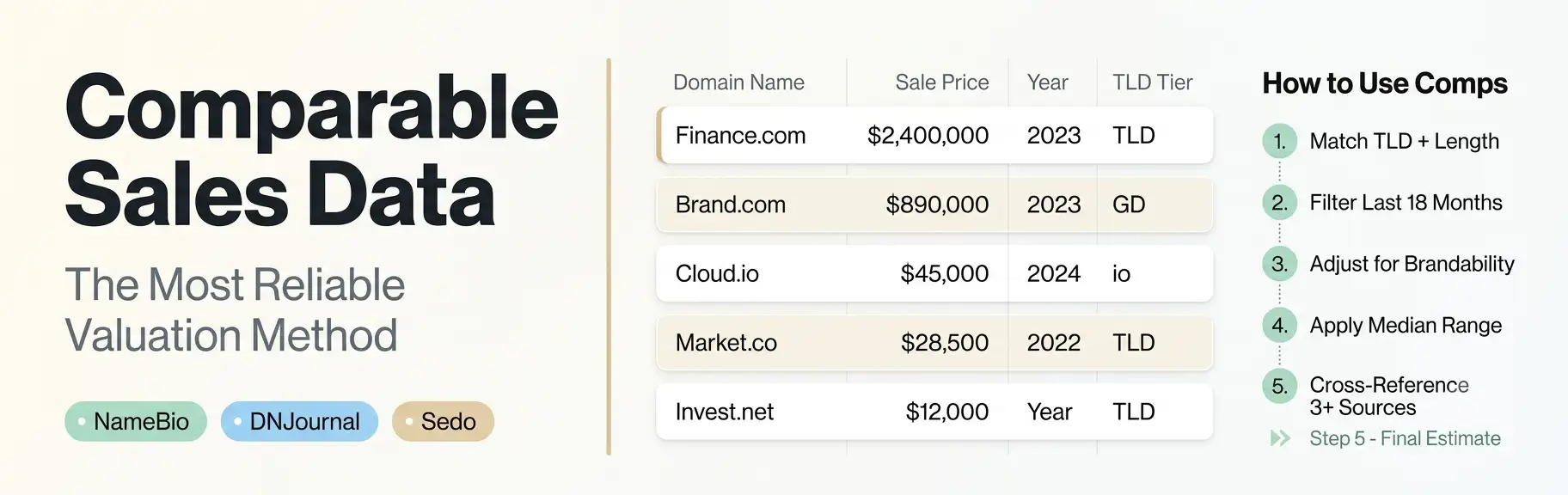
Primary sources for domain sales comps:
- NameBio.com – the most comprehensive public database of historical domain sales
- DNJournal.com – curated weekly sales reports with verification
- Sedo.com public data – marketplace transaction records
- DNWE.com – aftermarket sales and auction results
How to use comps effectively:
- Identify domains with the same TLD, similar character count, and comparable keyword category.
- Filter for sales within the last 12-18 months to account for market timing.
- Adjust for differences in keyword specificity, brandability, and extension.
- Apply a median-based range rather than anchoring to a single data point.
- Cross-reference at least three independent comp sources before finalizing an estimate.
Comps provide market-grounded price benchmarks rather than algorithmic guesses – which is why professional domain brokers rely on this method above all others for high-stakes transactions.
Factor 8: Traffic Metrics and Direct Navigation Value
Some domains generate measurable, organic type-in traffic – visitors who type the domain directly into their browser without a search engine referral. This direct navigation traffic has genuine monetary value because:
- It represents brand awareness already established in the market
- It can be monetized immediately through parking, advertising, or affiliate offers
- It demonstrates proven demand for the domain’s keyword or brand
Traffic value assessment checklist:
- Monthly unique visitors (verified via Similarweb or independent analytics)
- Traffic source breakdown (direct vs. referral vs. organic)
- Geographic distribution of visitors
- Revenue generated from parking or monetization (if any)
- Consistency of traffic over 6-12 months (no sudden spikes that may indicate artificial inflation)
Type-in traffic is increasingly rare in the mobile-first era, where users default to search and apps rather than direct URL entry. However, for strong generic keywords, meaningful type-in volumes still exist and can add significant value. A domain generating 1,000 organic visitors per month at a monetization rate of even $0.10 per visit represents $100/month, or $1,200/year in baseline income – a figure that directly informs valuation multiples.
Factor 9: Legal History – Trademarks, UDRP Disputes, and Encumbrances
Legal history is one of the most under-examined but potentially devastating factors in domain valuation. A domain with an unresolved legal encumbrance, a prior UDRP dispute, or a trademark conflict can be effectively worthless despite strong scores on every other metric.
Legal risk categories to investigate:
- Trademark conflicts: Does the domain string match or closely resemble a registered trademark? WIPO’s UDRP (Uniform Domain-Name Dispute-Resolution Policy) allows trademark holders to recover domains through arbitration. A domain that is confusingly similar to a live trademark carries compulsory legal risk.
- UDRP complaint history: Domains that have previously been subject to a UDRP complaint – even if the complaint was unsuccessful – carry reputational and legal residue that can impair buyer confidence and future value.
- Spam and malware blacklisting: Domains formerly used for phishing, spam networks, or malware distribution may be permanently blacklisted by email providers, browser security databases, and Google’s Safe Browsing list. These penalties often survive ownership transfer.
- Court-ordered seizures: A domain involved in prior criminal or civil proceedings may carry court-record encumbrances that create liability for any future acquirer.

Due diligence tools for legal history:
- WIPO UDRP case search: wipo.int/amc/en/domains/search
- Google Safe Browsing Transparency Report
- MXToolbox for email blacklist status
- Wayback Machine (archive.org) for historical content review
Never acquire a premium domain without completing a full legal history audit. The cost of this due diligence is trivial relative to the risk exposure of an encumbered acquisition.
Factor 10: Category Liquidity and Buyer Pool Depth
A domain’s true market value is a function of how many qualified buyers exist for that specific category at any given time. This concept – buyer pool depth – is often overlooked by novice appraisers who focus exclusively on the asset’s intrinsic qualities.
High-liquidity domain categories (large, active buyer pools):
- Finance, insurance, and mortgage terms
- Technology and SaaS-related words
- Health, medical, and wellness keywords
- Legal services terminology
- Real estate and property terms
- E-commerce and retail keywords
Lower-liquidity categories (smaller, more specialized buyer pools):
- Hyper-specific technical jargon
- Regional or culturally specific terms
- Emerging technologies with unproven markets
- Acronyms without dominant interpretations
A domain in a high-liquidity category will sell faster and command stronger prices than an objectively “nicer” domain in a thin market. Liquidity affects not just the price achievable, but also the time-to-sale, which has real financial implications for investors managing portfolio carrying costs.
Suggested visual: Liquidity Heat Map A category-by-category heat map showing relative buyer pool density across major domain industry verticals. High-liquidity categories shown in green gradients; low-liquidity categories in cooler tones.
Factor 11: Market Timing and Macro Demand Cycles
Even the strongest domain asset will underperform if listed during a broad market contraction. Domain prices, like all asset markets, are influenced by macro cycles:
- Bull market conditions: Low interest rates, high startup formation rates, and increased venture capital activity all drive up demand for premium domain names. End-user buyers have more capital to deploy and a stronger business case for brand investment.
- Bear market conditions: Recessionary pressure, rising capital costs, and reduced startup funding compress domain valuations as discretionary brand investment budgets shrink.
- Category-specific demand spikes: The emergence of a new technology sector (AI, Web3, biotech) creates short-term demand surges for relevant domain names. Domains containing terms like “AI” or “GPT” experienced significant appreciation cycles following the generative AI adoption wave of 2022-2024.
Strategic timing insights for sellers:
- List premium assets during periods of peak category relevance, not just when personal liquidity pressure drives the sale.
- Monitor comparable category sales velocity as a leading indicator of market temperature.
- Align premium domain offers with industry conference calendars, when buyer decision-makers are most active and accessible.
Strategic timing insights for buyers:
- Counter-cyclical acquisition during market downturns offers the strongest long-term return potential.
- Motivated sellers in contracting markets frequently accept prices significantly below peak valuations.
- Acquiring before a category demand spike – rather than during it – is the key to asymmetric upside.
How Domain Names Are Valued: The Professional Appraisal Process
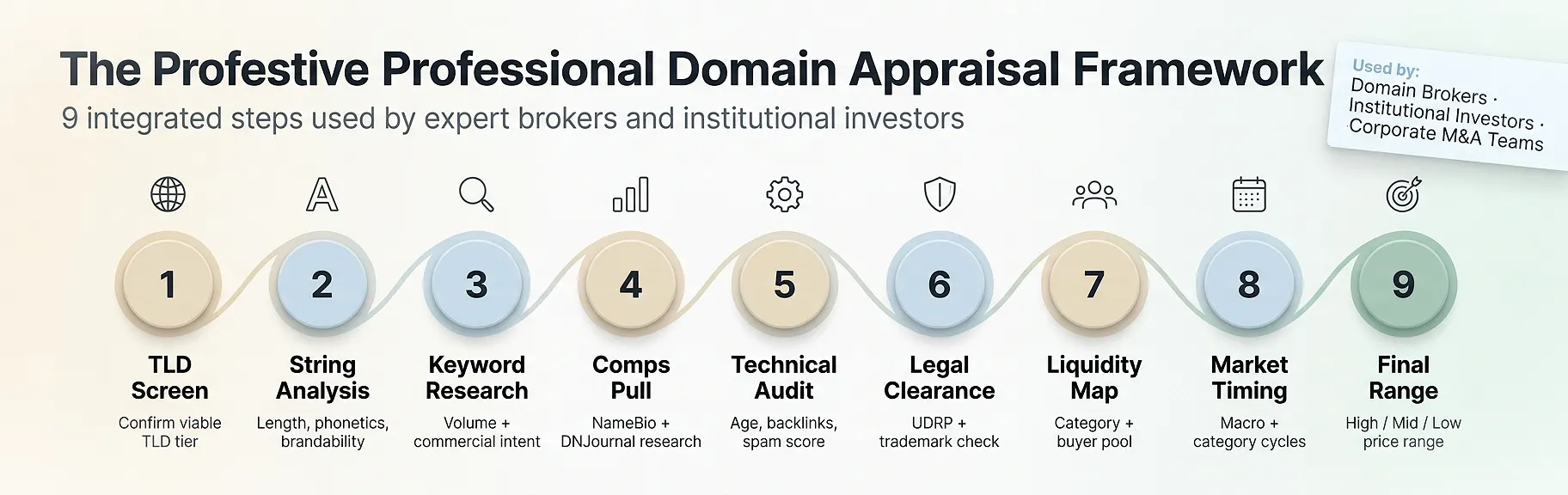
Understanding these 11 factors individually is important – but professional domain appraisers apply them as an integrated framework, not as a simple checklist. Here is how a structured appraisal typically flows:
Step 1 – TLD and Extension Screening Confirm the domain is in a commercially viable TLD tier. If not .com, document the discount applied.
Step 2 – String Analysis Evaluate character length, phonetics, brandability score, and presence of hyphens or numerals.
Step 3 – Keyword Research Pull search volume, competition density, and commercial intent data for any keyword components.
Step 4 – Comparable Sales Pull Research NameBio and DNJournal for sales of comparable domains within the past 18 months.
Step 5 – Technical Audit Check domain age, backlink profile, spam score, blacklist status, and historical traffic.
Step 6 – Legal Clearance Run UDRP history, trademark conflict check, and court-record review.
Step 7 – Liquidity Assessment Map the domain to its category and estimate buyer pool depth and time-to-sale range.
Step 8 – Market Timing Overlay Adjust valuation range based on current macro conditions and category-specific demand cycles.
Step 9 – Final Range and Confidence Interval Synthesize all factors into a defensible price range with high, mid, and low estimates based on different buyer scenarios.
Common Mistakes in Domain Valuation
Even experienced domain investors make these errors. Avoiding them protects both buyers and sellers from costly miscalculation:
- Relying on automated appraisal tools alone. Tools like Estibot and GoDaddy Appraisals use algorithmic signals and frequently miss brandability, buyer psychology, and market timing entirely. Use them as a starting point, never an endpoint.
- Ignoring the legal history. Many buyers skip the UDRP and trademark check on the assumption that “it looks clean.” This assumption has cost investors hundreds of thousands of dollars in forced transfers and legal fees.
- Anchoring on acquisition cost. What a seller paid for a domain has no relevance to its current market value. Price anchoring to purchase price is a cognitive bias that leads to both overpricing and underpricing.
- Confusing domain popularity with domain value. A domain receiving high search volume for its keyword does not guarantee comparable end-user demand. The buyer pool must be validated, not assumed.
- Underestimating the TLD discount. Sellers of non-.com domains consistently overvalue their assets relative to what the market will actually pay. The .com premium is structural and persistent.
- Neglecting toxic backlink audits. Acquiring a domain with thousands of spammy inbound links can result in inheriting a Google penalty that takes months of disavow work to resolve – destroying any projected SEO value.
Expert Tips for Buyers of Ultra Premium Domain Names
If you are considering entering the upper tier of the domain market, these principles apply:
- Prioritize .com exclusivity: No alternative extension replicates the trust, memorability, and resale liquidity of a .com in the premium tier.
- Think in decades, not quarters: Ultra premium domains are long-duration assets. The most significant realized gains come from patient, strategic holding rather than rapid flipping.
- Verify comps with multiple sources: A single sale on Sedo does not establish market value. Cross-reference NameBio, DNJournal, and direct broker data before committing to a price.
- Engage a qualified broker: For transactions above $25,000, the negotiation expertise, market relationships, and legal documentation skills of a specialist domain broker typically generate returns that far exceed their fee.
- Focus on end-user demand: The most liquid premium domains are those where a large pool of active businesses would benefit from owning the name – regardless of whether they are currently in the market.
Domain Valuation Factor Comparison Table
| FACTOR | CATEGORY | IMPACT LEVEL | MEASURABLE? | TOOLS TO USE |
|---|---|---|---|---|
| TLD Extension | Technical | Critical | Yes | Registry data |
| Character Length | Technical | Very High | Yes | Manual count |
| Commercial Keyword Intent | Market | Very High | Yes | Google KP, Ahrefs |
| Brandability Score | Market | Critical | Partially | Human judgment |
| Domain Age | Technical | Moderate | Yes | WHOIS history |
| Backlink Profile | Technical | High | Yes | Ahrefs, SEMrush |
| Comparable Sales | Market | Critical | Yes | NameBio, DNJournal |
| Type-In Traffic | Technical | Moderate-High | Yes | Similarweb |
| Legal History | Risk | Critical | Yes | WIPO, WHOIS |
| Category Liquidity | Market | High | Partially | Market knowledge |
| Market Timing | Market | High | Partially | Sales velocity data |
Frequently Asked Questions: How Domain Names Are Valued
Q: What is the most important factor in how domain names are valued? A: There is no single dominant factor - but TLD extension (.com vs. all alternatives), brandability, and comparable sales data consistently drive the largest differences in realized transaction prices. For investment-grade assets, .com exclusivity and end-user demand are the most critical variables.
Q: Do free domain appraisal tools give accurate valuations? A: Free automated tools like Estibot or GoDaddy's appraisal function provide a rough algorithmic baseline but are not reliable for premium or ultra premium domains. They cannot account for brandability, legal history, buyer pool depth, or market timing. Professional brokers and experienced investors always rely on human judgment combined with verified comparable sales data.
Q: How does domain age affect value? A: Domain age contributes to value primarily through accumulated authority - the backlinks, citations, and historical credibility a domain has built over years of active use. A parked domain of the same age carries little age premium. Active, continuously used domains with clean ownership histories are more valuable than newer domains with comparable technical characteristics.
Q: What makes a domain "ultra premium"? A: An ultra premium domain typically combines: a .com extension, a short character count (usually under 10 characters), a single generic or brandable word, no legal encumbrances, strong category liquidity, and comparable sales history in the six-to-seven-figure range. These names are finite, non-reproducible, and have permanently exhausted registration supply.
Q: Can the same domain be valued differently by different buyers? A: Yes - domain valuation is inherently buyer-specific. A domain worth $50,000 to a financial investor may be worth $500,000 to an end-user business for whom it represents a category-defining brand. This is why premium domain sales are often conducted through private negotiation rather than open auction - the negotiation process is designed to surface and capture end-user premium rather than settling for commodity market pricing.
Q: How do I know if a domain has a clean legal history? A: Run a UDRP complaint search through the WIPO UDRP case database, check the domain against trademark registries via the USPTO and EUIPO databases, review the domain's historical content via Wayback Machine, and run the domain through email blacklist check tools such as MXToolbox. For high-value acquisitions, retain an intellectual property attorney to confirm legal clearance.
Q: How do market conditions affect domain valuations? A: Domain values are sensitive to macro conditions including startup funding levels, interest rates, and category-specific technology adoption cycles. Bull market conditions with high startup formation rates drive end-user demand and price appreciation. Contracting markets compress realized values as buyer discretionary budgets shrink. Understanding where a category sits in its demand cycle is an essential part of how professional appraisers calculate market-adjusted valuations.
Understanding How Domain Names Are Valued Is a Competitive Advantage
The gap between what a domain looks like it should cost and what it actually commands in the open market comes down entirely to how well the seller - and buyer - understand these 11 valuation factors. Domains are one of the few digital assets that appreciate rather than depreciate over time, provided they are category-defining, technically clean, and legally unencumbered.
For anyone serious about acquiring investment-grade digital real estate, the appraisal process outlined in this article provides a professional, market-validated framework that goes far beyond surface-level impressions. Whether you are evaluating a $5,000 aftermarket acquisition or a $500,000 ultra premium name, the same disciplined methodology applies.
If you are ready to explore assets that already score at the highest tier across all 11 of these factors, browse our curated portfolio of ultra premium domains for sale at IUXOR - where every listed asset has been selected based on the exact criteria that drive institutional-grade domain value.
Discover Ultra Premium Domains for Sale →
Pingback: How to Sell a Premium Domain: Ultra Premium Seller Guide
Pingback: Domain Name Trademark Conflict: Avoid Disputes Early