
Before a visitor reads your headline, scans your pricing, or clicks a single button, your domain name has already made a judgment call on your behalf. In the first fraction of a second after typing or clicking your web address, a customer’s brain has silently decided whether your business feels legitimate, temporary, or worth trusting with a credit card. This is the quiet, underappreciated power of an ultra-premium domain for brand credibility, and it is the reason serious founders treat domain selection as a strategic decision rather than an afterthought.
Most business owners pour their energy into homepage copy, product photography, and checkout flow, assuming that credibility is built entirely on the page. In reality, the domain sits ahead of all of that in the trust-building sequence. For a closer look at how this asset class is priced and traded, Iuxor’s ultra premium domain names marketplace offers a curated starting point for founders who want to skip years of brand-building friction.
What is an Ultra-Premium Domain and Why Credibility Starts at the URL Bar
An ultra-premium domain is a short, clean, highly memorable web address, typically a single dictionary word, a recognizable brand-style term, or a tight two-word combination, registered on a trusted extension such as .com. It is the opposite of a domain stitched together from keywords, numbers, or hyphens to satisfy an early SEO checklist.
Credibility starts at the URL bar for a simple reason: it is the first piece of information a customer processes, and it arrives before design, copy, or social proof can do any persuading. Browsers, email clients, and search results all display the domain prominently, which means it functions as a silent headline running in parallel with everything else a business says about itself.
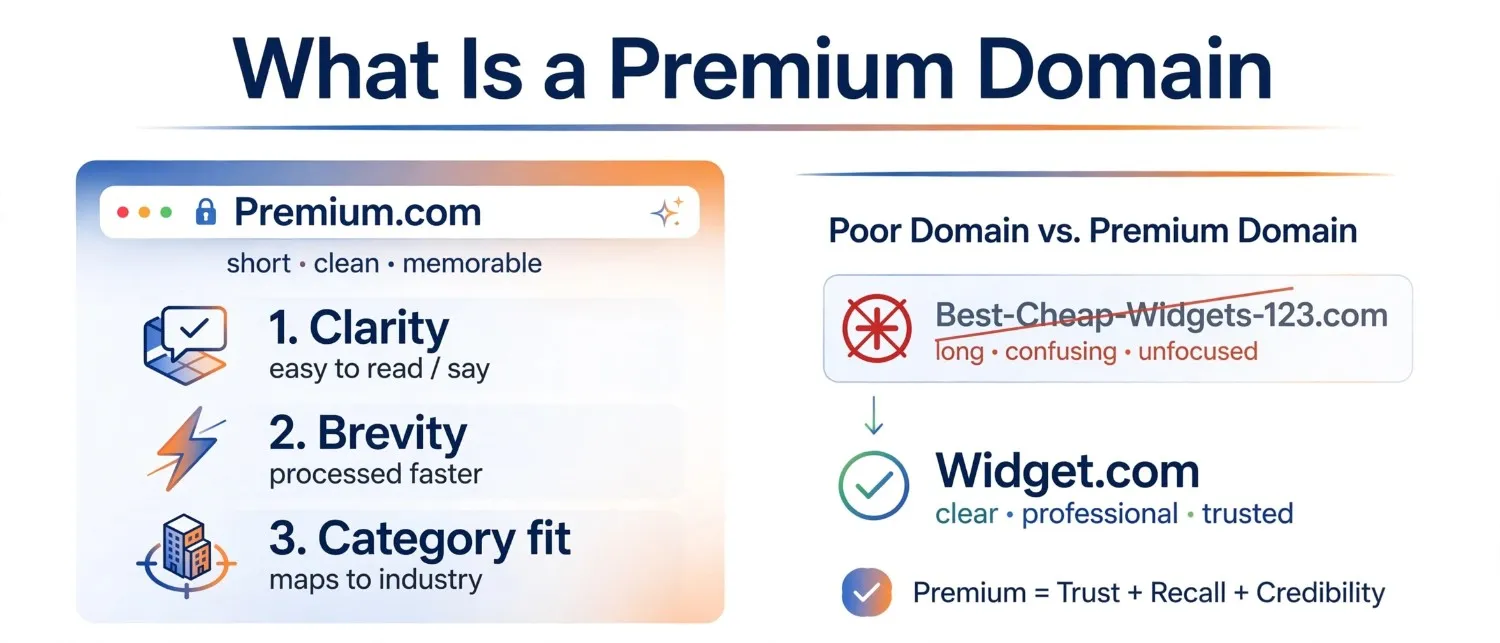
Three qualities define a domain that supports credibility rather than undermining it:
- Clarity – the name is easy to read, spell, and say out loud without hesitation.
- Brevity – shorter domains are processed faster and remembered longer.
- Category fit – the word or phrase maps naturally onto the industry or product it represents.
When a domain has all three, it disappears into the background of the customer’s attention, doing its job without drawing negative notice. When it lacks them, it becomes a small but persistent source of doubt.
The Psychology of First Impressions: How Visitors Judge a Domain in Milliseconds
Human beings are pattern-matching machines, and first impressions form far faster than conscious reasoning can intervene. Research on user trust and web design, including work published by the Nielsen Norman Group, has long shown that visitors form credibility judgments about a website almost instantly, often before any content has fully loaded. A domain name is one of the earliest inputs available to that snap judgment.
This matters because customers rarely audit their own reactions. They do not consciously think, “this domain has three hyphens, therefore it feels less trustworthy.” Instead, they feel a vague hesitation and either proceed anyway or quietly move on to a competitor. An ultra-premium domain for brand credibility short-circuits that hesitation before it forms.
There are a few psychological mechanisms at play:
- Fluency bias – the brain prefers information that is easy to process, and easy-to-read domains feel more trustworthy simply because they require less mental effort.
- Familiarity heuristics – domains that resemble the structure of well-known brands (single word, .com extension) borrow some of that established trust by association.
- Scarcity signaling – a short, clean domain implicitly communicates that the business either arrived early or invested seriously to acquire it, both of which suggest staying power.
None of these mechanisms require the visitor to know anything about domain markets. They operate below conscious awareness, which is exactly why so many founders underestimate the effect.
What an Ultra-Premium Domain for Brand Credibility Actually Signals
A domain name is a compressed message. Long before a customer reads a value proposition, the domain has already communicated several implicit claims about the business behind it.
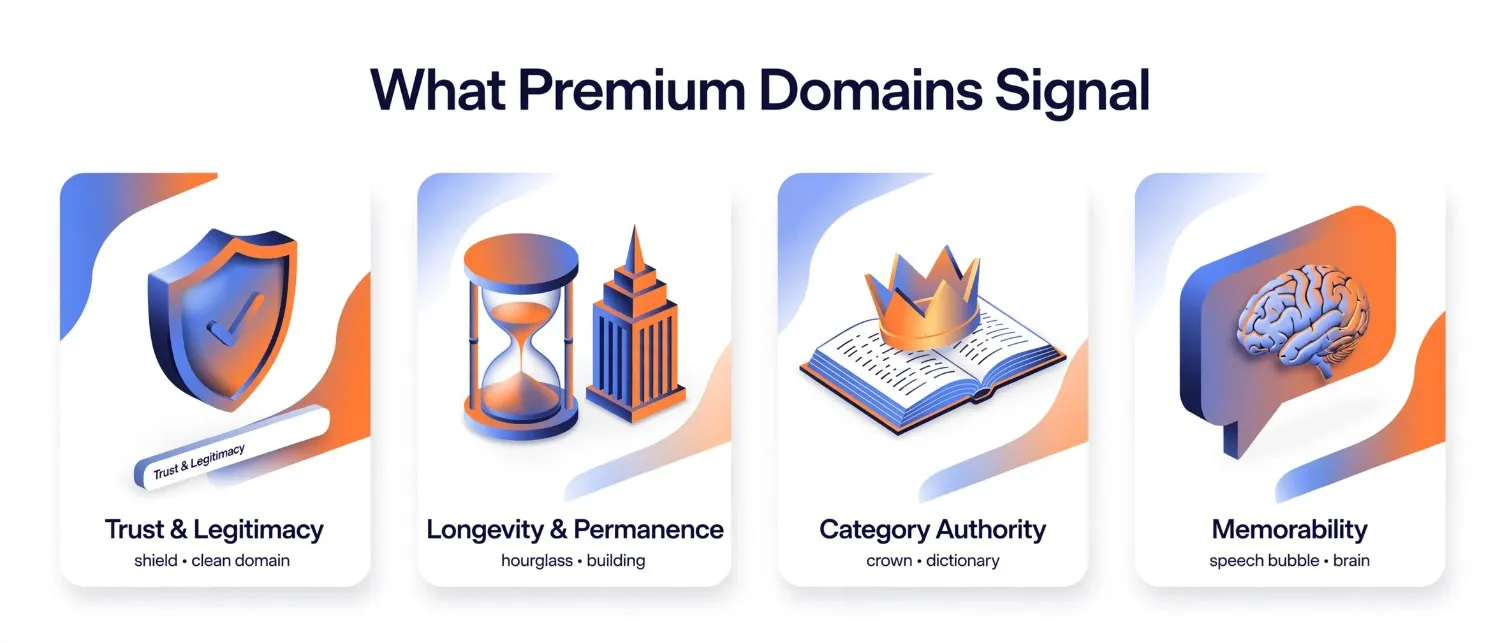
Trust and Legitimacy
A clean, professional domain suggests that a business has resources, planning, and staying power. Customers associate messy, keyword-stuffed domains with low-budget operations, and fairly or not, that association shapes purchase decisions, especially for anything involving payment information.
Longevity and Permanence
Short, valuable domains are expensive to acquire and are rarely abandoned. Customers subconsciously register this: a business sitting on an ultra-premium domain looks like it intends to be around next year, which matters enormously for anyone considering a subscription, a warranty, or a long-term relationship with a vendor.
Category Authority
When a domain matches the core word customers already associate with a product category, it borrows a form of built-in authority. It reads less like a company name and more like a category label, which positions the brand as a default choice rather than one option among many.
Memorability and Word-of-Mouth Potential
A domain that is easy to say out loud is far more likely to be shared verbally. Word-of-mouth referrals depend entirely on the listener being able to recall and correctly type the address later, and this is precisely where hyphenated or overly long domains quietly lose referral traffic.
Why This Matters More in Competitive, High-Trust Categories
Not every industry feels the effect of an ultra-premium domain equally. In categories where customers are handing over sensitive information, whether that is a payment method, personal health data, or a long-term financial commitment, the credibility tax imposed by a weak domain is significantly higher. Fintech, healthcare, legal services, real estate, and enterprise software all fall into this category, since the buyer’s mental checklist for “can I trust this” is longer and more cautious than it would be for, say, a casual hobby blog.
In these categories, an ultra-premium domain for brand credibility does more than look nice; it actively lowers the barrier a skeptical buyer must clear before they will even consider filling out a form. Conversely, in low-stakes categories such as entertainment or casual content, the effect still exists but is comparatively smaller, since the customer is risking less by proceeding.
This is one reason domain marketplaces increasingly segment premium inventory by industry relevance. A single, clean word that maps naturally onto a financial or professional services concept will often command a higher valuation than an equally short word tied to a niche hobby, simply because the credibility premium it delivers is worth more in dollar terms to the buyer.
Domain Extension Choices and What They Quietly Communicate
The extension attached to a domain, commonly called the top-level domain or TLD, carries its own layer of implicit meaning, separate from the name itself.
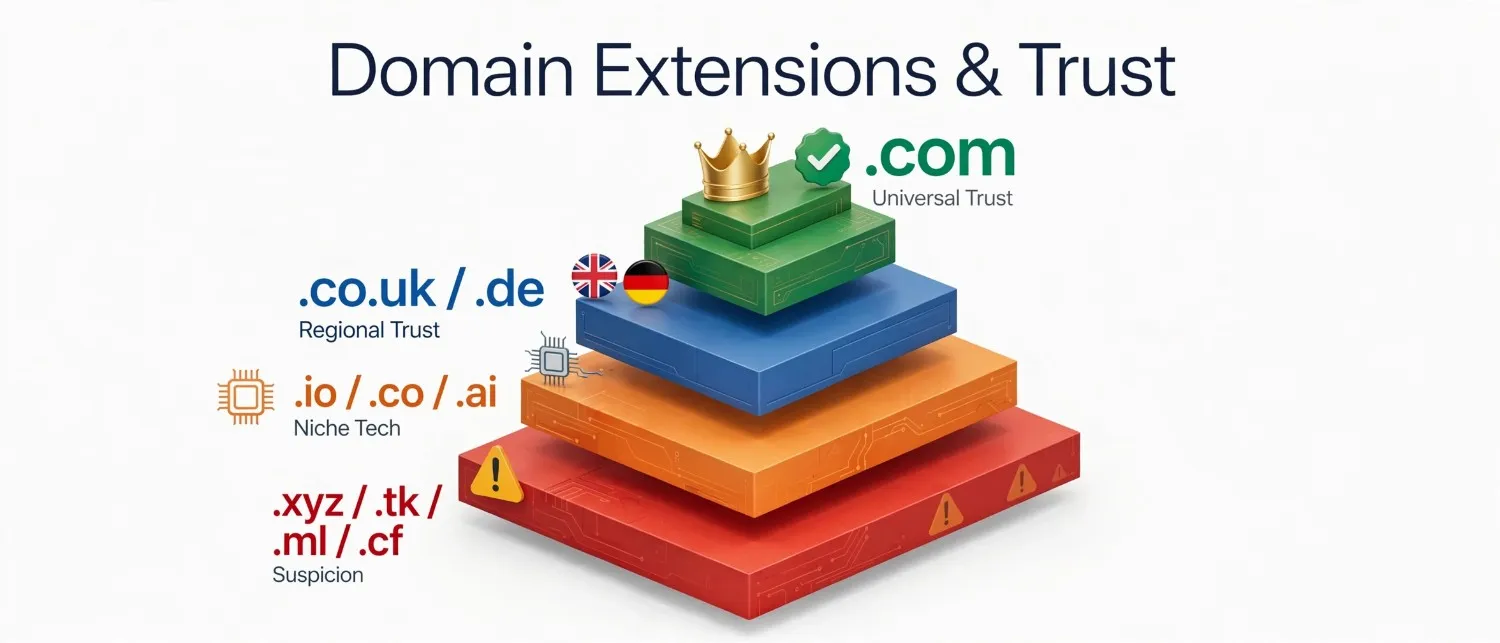
- com remains the default mental model for most internet users worldwide, and it is still the extension people type from memory when they cannot recall the exact address they were given.
- Country-code extensions (such as .co.uk or .de) can strengthen trust for a business explicitly serving that region, but may read as limiting for a company with global ambitions.
- Newer or alternative extensions (.io, .co, .ai) have carved out legitimate niches, particularly in technology, but they still require a moment of extra processing from users who are more accustomed to .com, and that extra moment is exactly the kind of friction an ultra-premium domain strategy tries to eliminate.
- Unfamiliar or obscure extensions can trigger outright suspicion, especially among less tech-savvy audiences who associate anything unfamiliar with a scam.
For businesses building long-term brand equity, defaulting to .com whenever the premium option is available remains the safest, most universally trusted choice, and it is the primary reason .com inventory continues to command a pricing premium across domain marketplaces.
How an Ultra-Premium Domain Supports Multi-Channel Branding
Modern customer journeys rarely begin and end on a website. A domain also has to function across business cards, podcast mentions, billboard advertising, social media handles, and email signatures, and each of these channels has its own tolerance for complexity.
- Podcast and radio ads depend entirely on a domain being understood correctly from audio alone, with no visual spelling cues available.
- Billboard and out-of-home advertising gives viewers only a few seconds to absorb and remember a web address while driving past at speed.
- Business cards and print materials benefit from a domain that looks clean in a small font without needing a QR code as a crutch.
- Social handles are far easier to secure consistently across platforms when the underlying brand name is short and distinctive.
- Email signatures built on a clean domain reinforce legitimacy every time an employee sends a message to a prospect or partner.
An ultra-premium domain effectively becomes a single asset that scales cleanly across every one of these channels without requiring a separate simplified version for each one, which is a quiet but meaningful operational advantage over a long or hyphenated alternative.
Ultra-Premium Domains vs Generic Domains: A Comparison
The table below breaks down how an ultra-premium domain for brand credibility typically compares against a generic, keyword-stuffed, or hyphenated alternative across the factors that influence customer trust.
| Factor | Premium Domain | Generic / Keyword-Stuffed Domain |
|---|---|---|
| First impression | Feels established and intentional | Feels improvised or low-budget |
| Memorability | High – easy to recall and repeat | Low – easy to forget or mistype |
| Verbal shareability | Simple to say and spell aloud | Awkward, often requires spelling out |
| Perceived investment | Suggests financial and strategic commitment | Suggests minimal upfront investment |
| Brand extension potential | Scales cleanly across products and markets | Locked into a narrow keyword niche |
| Email deliverability perception | Reads as a legitimate business address | More likely flagged as spam-adjacent |
| Long-term SEO equity | Retains value as algorithms evolve | Vulnerable to spam-pattern penalties |
Real-World Signals Customers Read Into Your Domain
Beyond the broad categories above, individual structural choices in a domain send very specific micro-signals. The table below summarizes the most common patterns and what customers subconsciously infer from each.
| Domain Pattern | Customer’s Subconscious Read |
|---|---|
| Single dictionary word (.com) | Established, well-funded, serious operation |
| Two clean words combined | Clear, modern, purpose-built brand |
| Multiple hyphens | Rushed setup, possible spam risk |
| Numbers replacing letters | Cheap workaround, lower trust |
| Unfamiliar extension for the region | Uncertainty about legitimacy or location |
| Long string of keywords | SEO-first thinking rather than customer-first |
Common Mistakes Businesses Make When Choosing a Domain
Even experienced founders repeat the same domain-selection errors, usually because they prioritize short-term SEO instincts over long-term brand equity.
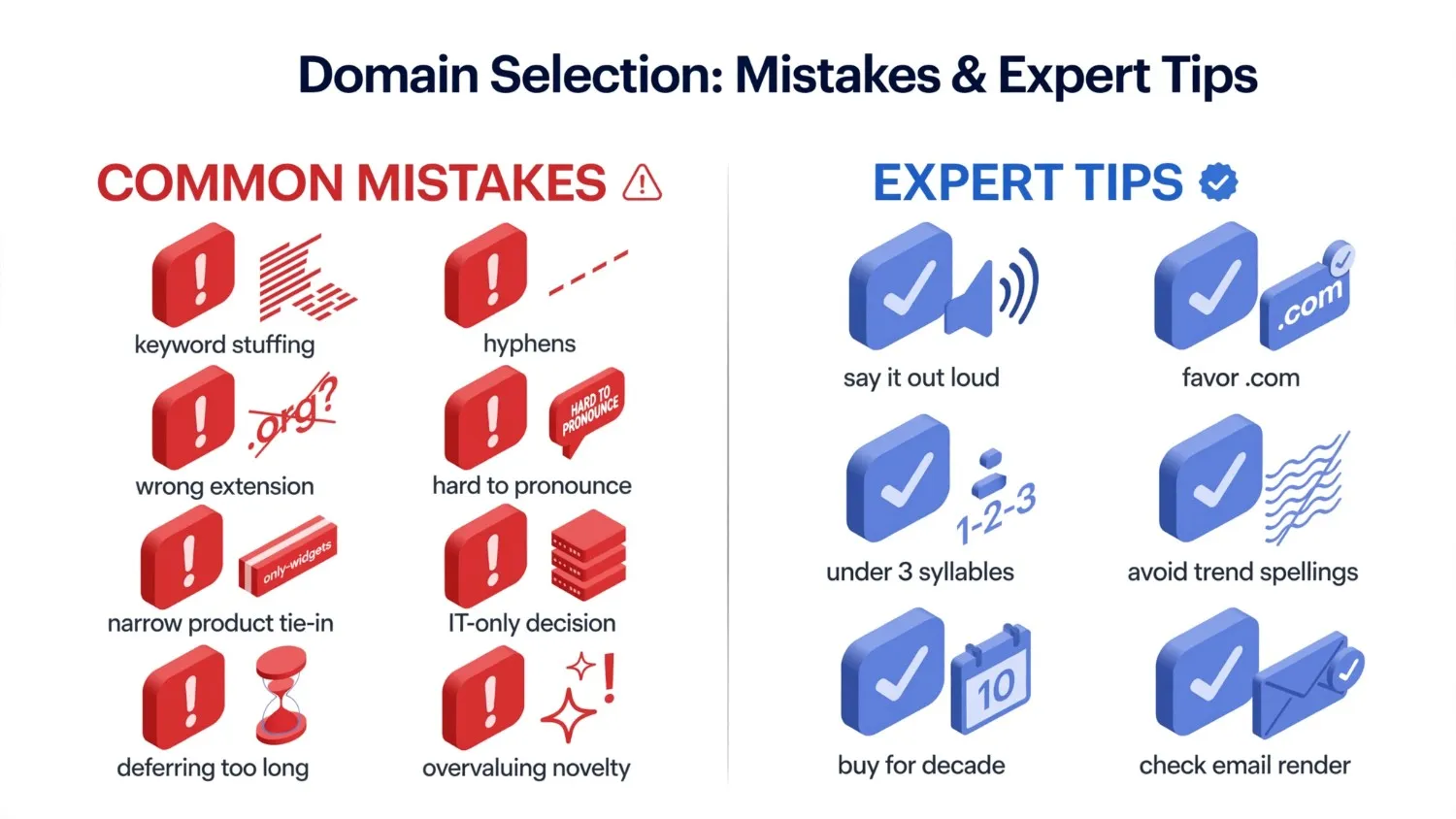
- Chasing exact-match keywords over brandability, resulting in clunky names that are hard to say aloud.
- Adding hyphens to secure an available string, without realizing hyphens correlate strongly with spam-pattern domains in the customer’s mind.
- Choosing an unfamiliar extension purely because the .com was taken, rather than negotiating for the ultra-premium version.
- Ignoring pronunciation and assuming a name that looks fine in text will also work when spoken in a podcast ad or referral conversation.
- Underestimating future scaling needs, locking a growing company into a domain tied to one narrow product line.
- Treating the domain as a technical decision handled by IT rather than a strategic decision owned by marketing and leadership.
- Deferring the decision too long, which often results in settling for a compromised name under time pressure right before a launch date, rather than securing the right domain early when negotiation leverage and options are both stronger.
- Overvaluing novelty at the expense of clarity, choosing a name that feels clever internally but confuses first-time visitors who have no context for the wordplay.
Expert Tips for Selecting an Ultra-Premium Domain for Brand Credibility
Founders who get this right tend to follow a similar discipline when evaluating domain options.
- Say it out loud before buying. If it needs to be spelled out over the phone, it will lose referral traffic.
- Favor .com unless there is a strong, deliberate brand reason to choose otherwise; customers still default to typing .com from memory.
- Keep it under three syllables where possible, since shorter names are retained more reliably in long-term memory.
- Avoid trend-driven spellings (dropped vowels, doubled letters) that look clever at launch but age poorly and confuse new customers.
- Buy for the next decade, not the current product line, since rebranding a domain later is costly and disruptive to existing trust.
- Check how it renders in email, since a domain that looks fine on a homepage can still look suspicious in a from-address.
Step-by-Step: How to Evaluate a Domain Before Buying
- List three to five name candidates that describe the core value of the business in the simplest possible terms.
- Read each one aloud to a colleague without spelling it, and note which ones are understood correctly the first time.
- Check availability across the primary extension first, and only consider alternatives if the .com is genuinely unattainable.
- Run a quick trademark and search-engine check to confirm the name is not already strongly associated with an unrelated brand.
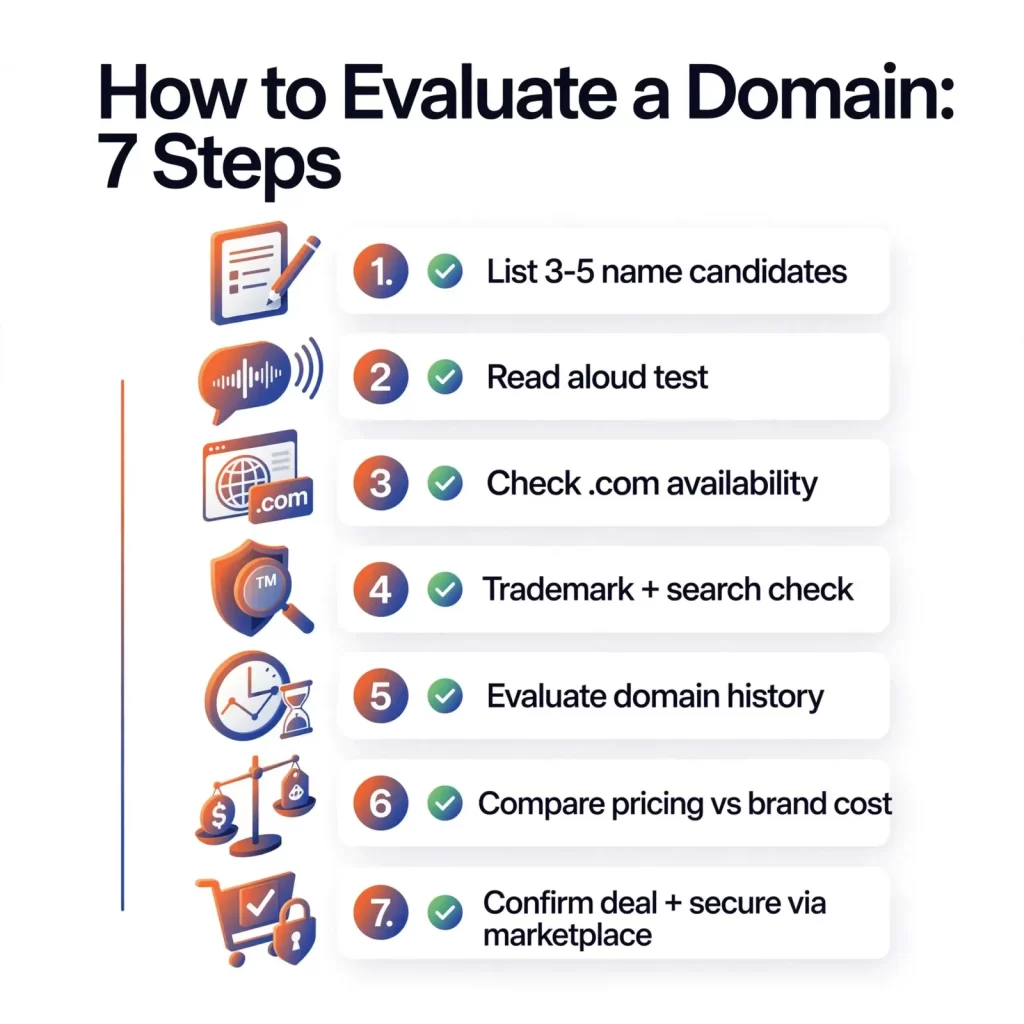
5. Evaluate the domain’s history, since a domain with prior credible use often carries residual trust signals, while one with a spam history can carry the opposite.
6. Compare pricing and long-term value against the cost of building equivalent brand recognition from scratch. Iuxor’s guide on domain names as an investment-grade asset class is a useful reference point for thinking about this trade-off in financial terms.
7. Confirm the deal structure and secure the domain through a reputable marketplace or broker before finalizing brand assets built around the name.
How Domain Choice Affects SEO and Visibility in AI Overviews
Search engines have shifted decisively toward rewarding people-first, trustworthy content, and that shift extends to the signals a domain itself communicates. Google’s own guidance on creating helpful, reliable content emphasizes experience, expertise, authoritativeness, and trustworthiness as ranking considerations, and a domain’s structure quietly feeds into how both users and algorithms assess that trustworthiness.
A few specific effects are worth noting:
Spam pattern detection
Search engines have become more aggressive about identifying keyword-stuffed and hyphen-heavy domains as low-quality signals, particularly following recent core and spam updates.
Click-through behavior
In search results, a clean domain earns more clicks purely on appearance, and click-through rate remains an important behavioral signal.
AI Overview extraction
As AI-generated answers pull directly from trusted sources, a domain that already reads as authoritative is more likely to be surfaced as a citation-worthy source rather than filtered out.
Brand search volume
A memorable domain generates more direct, branded searches over time, and branded search volume is itself a durable authority signal that generic domains rarely accumulate.
For businesses evaluating whether a specific domain carries genuine long-term value, Iuxor’s breakdown of the technical market factors behind domain valuation walks through how age, extension, keyword relevance, and search history combine to determine a domain’s real worth.
An Illustrative Scenario: Two Startups, One Product
Consider two hypothetical startups launching an identical software product on the same day, with the same design budget and the same marketing spend. One operates on a short, clean domain. The other operates on a hyphenated, keyword-packed alternative because the clean option was unavailable.
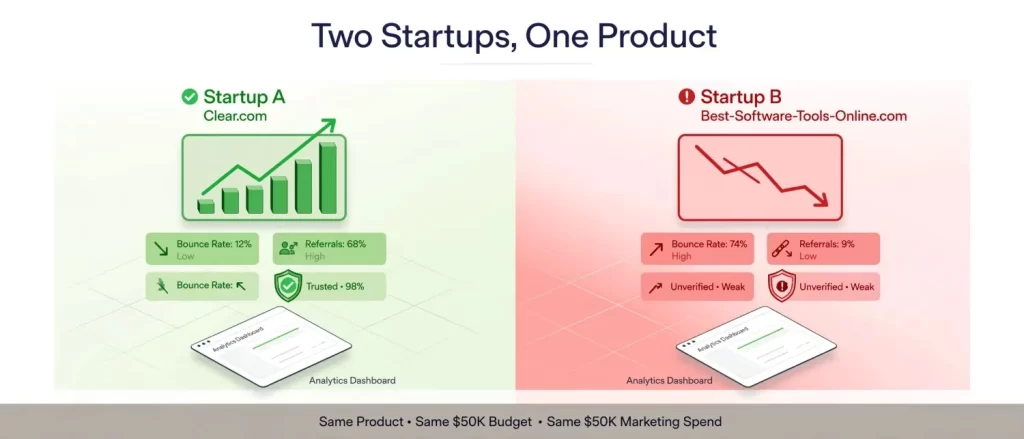
Within the first few months, the pattern that tends to emerge is consistent with the psychology described earlier in this article: the business with the cleaner domain experiences fewer bounce-and-hesitate moments at the point of signup, a higher rate of correctly recalled referrals, and a modest but compounding advantage in direct, branded search traffic. Neither business changes its product. The domain alone shifts the baseline trust customers extend before evaluating anything else.
The Financial Case: Domain Cost vs the Cost of Building Trust Manually
Founders often hesitate at the sticker price of an ultra-premium domain without comparing it against the realistic alternative cost of building equivalent trust through other channels. Consider the typical levers a business pulls to manufacture credibility when it lacks a strong domain:
- Extended content marketing campaigns run over many months to slowly build organic authority.
- Paid advertising spend used to compensate for lower organic click-through rates caused by an unfamiliar-looking web address.
- Design and development investment poured into a homepage that has to work harder to overcome an initial trust deficit.
- Public relations and influencer partnerships used to borrow credibility from third parties because the domain itself does not lend any.
Each of these is a recurring, ongoing cost. An ultra-premium domain, by contrast, is a one-time acquisition that continues delivering a trust dividend on every single visit, indefinitely, without requiring repeated spend. When viewed this way, the domain functions less like a marketing expense and more like a durable brand asset sitting on the balance sheet, comparable in spirit to acquiring a strong trademark early rather than fighting for recognition later.
This framing is also why serious buyers increasingly treat domain acquisition as a capital allocation decision rather than a routine operational task, weighing it against other uses of the same budget and asking which produces a longer-lasting return.
FAQ
What is an ultra-premium domain for brand credibility?
An ultra-premium domain for brand credibility is a short, memorable, keyword-relevant web address that signals legitimacy, permanence, and authority to visitors before they read a single line of on-page content.
Does an ultra-premium domain actually improve conversion rates?
Yes. An ultra-premium domain reduces the cognitive friction a visitor experiences when deciding whether a business is trustworthy, which shortens the path to a conversion decision.
Is an ultra-premium domain worth it for a new business?
For businesses planning to invest in long-term brand equity, an ultra-premium domain is often worth the upfront cost, since it removes a recurring credibility tax that generic domains impose on every visitor interaction.
What makes a domain name look untrustworthy to customers?
Excessive hyphens, unfamiliar extensions, numbers substituted for letters, and long strings of unrelated keywords are the most common patterns that make a domain look untrustworthy.
How do I evaluate whether a domain is ultra-premium enough for my brand?
Evaluate length, pronounceability, extension, keyword relevance, brandability, and how the domain reads aloud when someone recommends it verbally to a friend or colleague.
Can a business rebrand onto an ultra-premium domain later, or is it best to start with one?
A business can rebrand later, but doing so means transferring years of accumulated search rankings, email deliverability history, and customer memory onto a new address, which is always harder and slower than starting with the right domain from day one.
Does an ultra-premium domain replace the need for good design and content?
No. An ultra-premium domain lowers the initial trust barrier, but it still needs to be backed by clear messaging, credible content, and a well-designed site; the domain opens the door, and everything else determines whether the visitor stays.
Conclusion
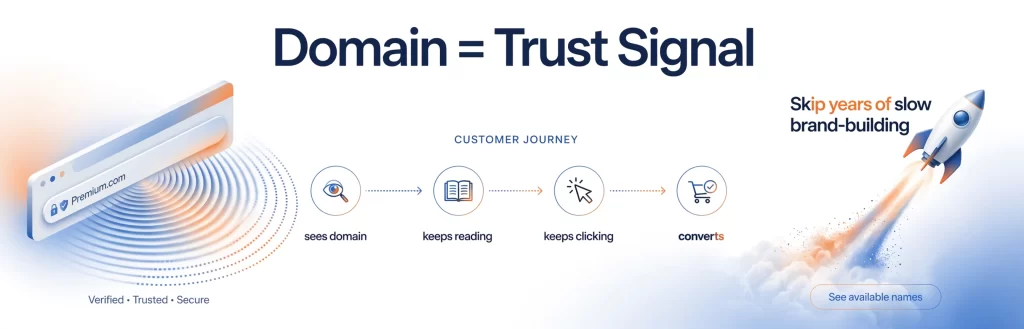
A domain name is never just an address; it is a compressed, always-on trust signal that runs ahead of every other marketing asset a business owns. Choosing an ultra-premium domain for brand credibility means choosing to remove friction at the exact moment a customer is deciding whether to keep reading, keep clicking, or move on. For founders ready to skip years of slow brand-building and acquire that trust signal directly, and see which names are available for your next launch.